Loading...
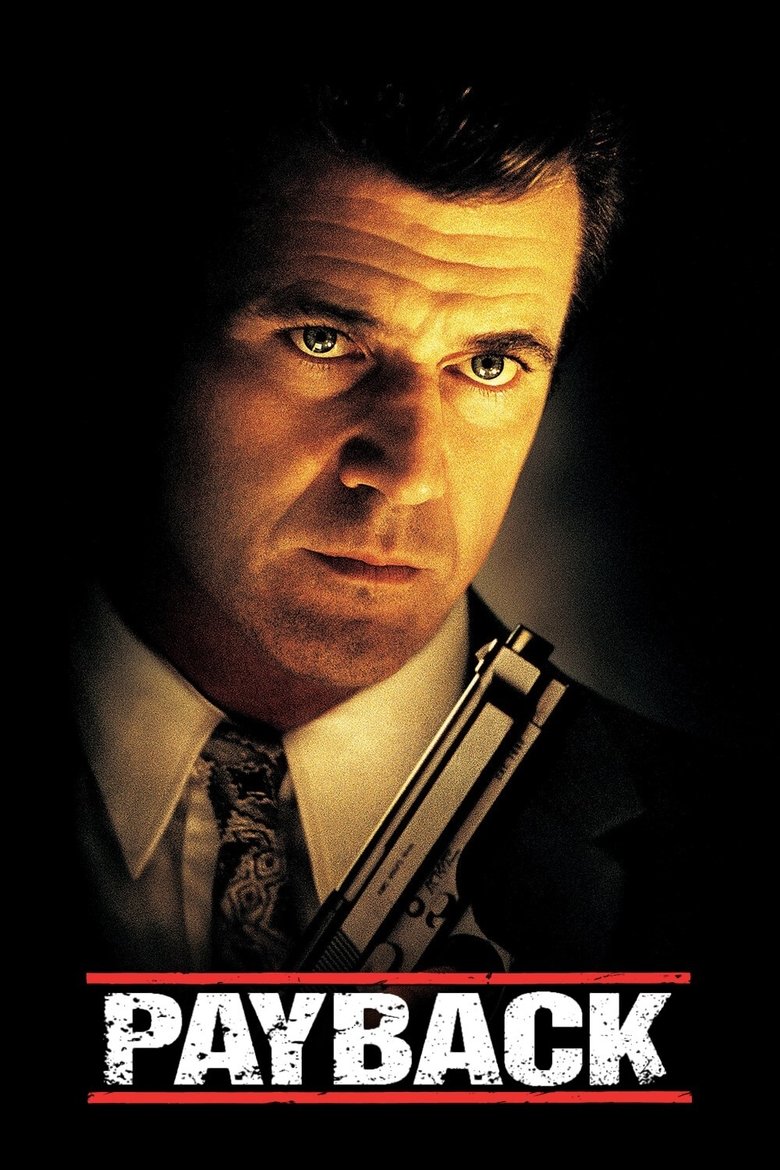
Payback (1999)
6
RecommendedDirected by Brian Helgeland· 100 min· 5 min read
My Review
Payback is a 1999 neo-noir crime thriller written and directed by Brian Helgeland in his directorial debut, starring Mel Gibson as Porter, a career criminal left for dead by his wife and his partner who returns to collect the money he is owed. Lucy Liu, Gregg Henry, Maria Bello, David Paymer, Bill Duke, William Devane and Kris Kristofferson round out the cast. It is based on The Hunter, the 1962 novel by Donald E. Westlake writing as Richard Stark.
There is a scene in this film where Mel Gibson stands up through the sunroof of a car holding two guns. One of them holds twelve bullets. The other is a six shooter. So naturally he proceeds to fire approximately three hundred rounds without once needing to reload. He then drops back into the car, fires another thirty, and finally, eventually, runs out.
Nineties cinema. Peak.
Some context on why I watched this. Two weeks ago I reviewed Play Dirty, and while researching that one I discovered that Mel Gibson had played the same character years earlier. This is an adaptation of The Hunter, the first Parker novel. Although he is not called Parker here. He is called Porter, because Westlake declined to licence the Parker name unless the studio committed to building an entire series around him. It is also the second adaptation of that same novel, following John Boorman’s Point Blank in 1967, which starred Lee Marvin and is widely considered a genuine classic.
Lucy Liu is in this, and I am ashamed at just how clichéd and racist the portrayal of her ethnicity is. She plays Pearl, a sadistic dominatrix who leads a group of Asian gangsters, and essentially every element of that is a stereotype lifted off the shelf.
And here is the detail that makes it considerably worse rather than better. In the novel, that character is a meek prostitute. That is the whole role. The dominatrix, the gang, the martial arts, the entire construction was invented for this film. None of it originates in the source material. Somebody sat in a room in the late nineties and actively chose to add all of that, which is a different and worse thing than inheriting it from a 1962 book.
She does, in fairness, beat the heck out of a man and take visible joy in it, so there is that.
Now, the production story, which is considerably more interesting than the film itself.
Brian Helgeland wrote and directed this. It was his directorial debut, and he arrived at it straight off winning an Academy Award for his screenplay for LA Confidential. The film he delivered was dark, bleak and mean, in keeping with the novel.
Do you agree with this review?
Sign in to add this to your watchlist, mark it seen, and save your own rating.
Reviewed on October 28, 2026
Share: