Loading...
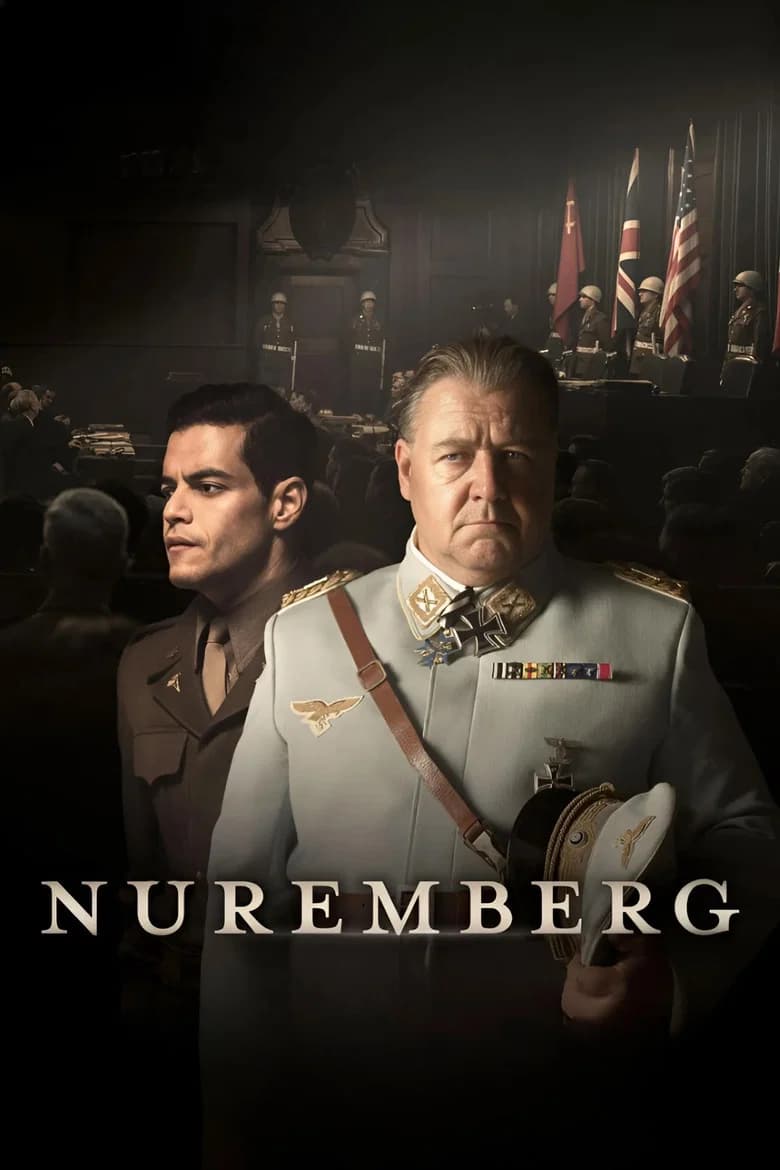
Nuremberg (2025)
5
RecommendedDirected by James Vanderbilt· 149 min· 5 min read
5
Nuremberg (2025)
RecommendedDirected by James Vanderbilt· 149 min· 5 min read
In postwar Germany, an American psychiatrist must determine whether Nazi prisoners are fit to go on trial for war crimes, and finds himself in a complex battle of intellect and ethics with Hermann Göring, Hitler's right-hand man.
My Review
Nuremberg is a 2025 historical drama written and directed by James Vanderbilt, adapted from Jack El-Hai’s book The Nazi and the Psychiatrist. Russell Crowe plays Hermann Göring, Rami Malek plays Douglas Kelley, the American army psychiatrist assigned to assess him, and Michael Shannon plays Robert H. Jackson, the United States Supreme Court Justice who served as chief prosecutor at the trials. It premiered at Toronto in September 2025 and holds a Metascore of 61.
There is a moment where Göring says something to the effect of, do you not see us as people. He is speaking about the men on trial alongside him. Men who, regardless of whether their individual role was large or small, participated in the worst thing human beings have ever organised against one another.
I sat there and I felt nothing.
There was not one moment of pity available to me across the entire film. Not for their pleas about their families. Not for the tears shed about what was happening to them, or what was about to. None of it reached me, and I did not want it to.
And I am upset about how it ended for them, because what I wanted was for them to suffer in the way the people whose lives they ended or permanently altered had suffered.
Which brings me to something I had wrong, and which I think makes it considerably worse rather than better. I assumed Göring was hanged. He was not. On the night of 15 October 1946, hours before he was due to be executed, he took cyanide in his cell. Ten other men were hanged the following morning. The most senior surviving figure of the entire regime found a way out at the last possible moment, and the thing I wanted for him never happened.
Now I want to address the argument the film gives him, because I think it needs handling properly.
Göring’s defence, in essence, is that everybody has blood on their hands. He raises the fact that after Pearl Harbor the United States interned Japanese Americans. He raises what the Soviet Union did during the war. And what he is reaching for is the conclusion that nobody in that courtroom has the standing to judge him.
Two things need saying at once. Japanese American internment was a genuine and serious injustice, and the United States should carry it. Soviet atrocities during that war are documented history. Neither of those is controversial and neither should be waved away.
But what Göring is doing with them is not a moral argument. It is a deflection, and it has a name. It is called the tu quoque defence, which translates roughly as “you did it too,” and it was the central strategy of the Nazi legal defence throughout these proceedings. The tribunal rejected it, and rejected it as a matter of law, because it is not a defence to crimes against humanity. Nothing any other nation did transforms the systematic, industrialised murder of six million people into something smaller or more comparable. Those are not equivalent in scale, in method or in intent, and Göring was not confused about that. He was looking for an exit and that was the only door available to him.
Do you agree with this review?
Sign in to add this to your watchlist, mark it seen, and save your own rating.
Reviewed on October 16, 2026
Share: