Loading...
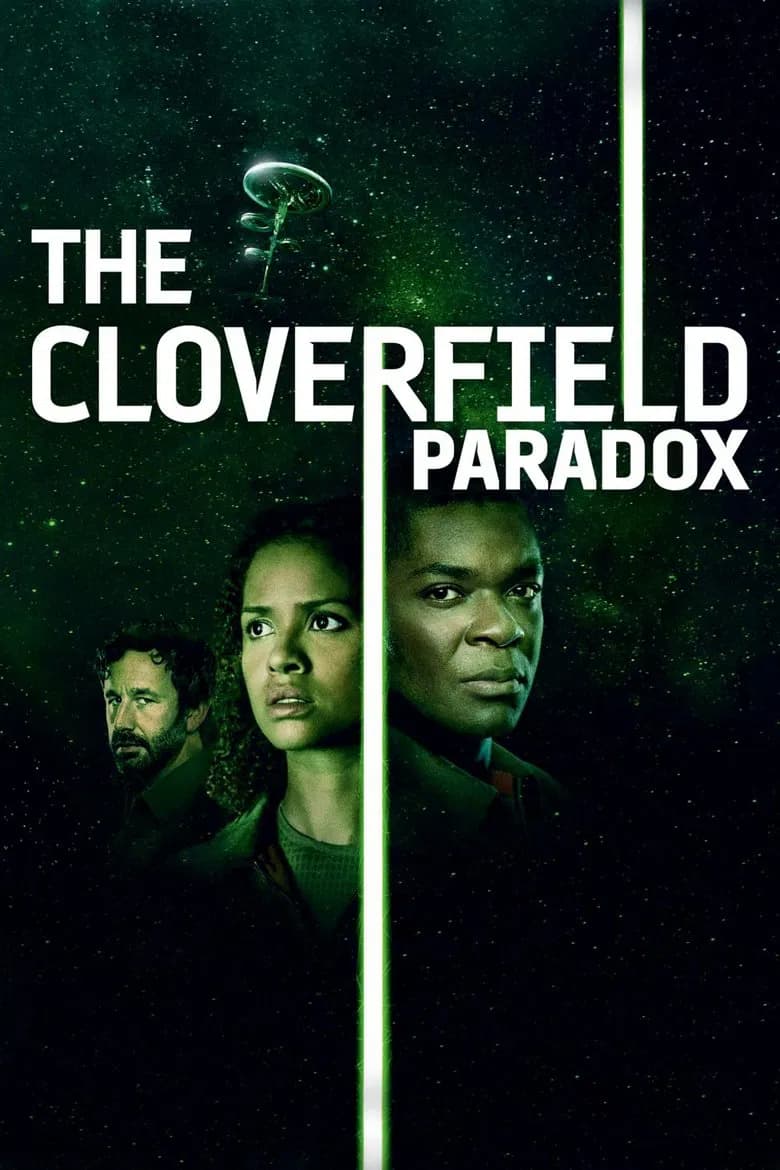
The Cloverfield Paradox (2018)
2
Not RecommendedDirected by Julius Onah· 102 min· 4 min read
2
The Cloverfield Paradox (2018)
Not RecommendedDirected by Julius Onah· 102 min· 4 min read
My Review
The Cloverfield Paradox is a 2018 science fiction horror film directed by Julius Onah, written by Oren Uziel and Doug Jung, produced by J.J. Abrams and Lindsey Weber, and released on Netflix. It runs 102 minutes, was made for around forty-five million dollars, and carries a genuinely impressive cast including Gugu Mbatha-Raw, Daniel Brühl, Elizabeth Debicki, David Oyelowo, Chris O'Dowd and Zhang Ziyi, with cinematography by Dan Mindel and a score by Bear McCreary. Set in 2028, it follows the crew of a space station conducting particle accelerator experiments to solve an energy crisis, who instead tear a hole into an alternate universe.
Let me describe the experience of watching it, because I think the sensation is the review. You know that feeling when a sneeze is coming? It is right there, it is loaded, you are fully committed, and then somebody says something and it simply evaporates, leaving you with your face half-assembled and nowhere to put the energy. That is this film, for roughly ninety consecutive minutes. It is perpetually about to become interesting and it never does.
There are genuinely portions of this I enjoyed. There are two. The first ten minutes, which are tense and well staged and suggest a considerably better film is coming. And the credits finally rolling.
I should also declare that this is my first ever encounter with the Cloverfield franchise, which I have since discovered is a bit like being introduced to a family through their least popular cousin.
And the reason for that is the single most illuminating fact about this production. This was never a Cloverfield film. It began life as an original spec script called God Particle, entirely unconnected to anything, and was only retrofitted into the franchise partway through, after the surprise success of 10 Cloverfield Lane, which had itself started as a standalone script called The Cellar. Somebody realised there was commercial value in taking nearly-finished films and stamping the Cloverfield name on them, and this is the result.
You can feel every inch of that decision. The connective material is stapled on rather than woven in, and critics at the time described it as taking a sledgehammer to the mythology. Every time the film remembers it is supposed to belong to something larger, it pauses to explain itself, and each explanation makes the whole enterprise duller than it was a minute earlier. There is a news broadcast sequence early on that essentially outlines the entire premise and all its consequences in advance, which removes whatever tension the film had been building.
Do you agree with this review?
Sign in to add this to your watchlist, mark it seen, and save your own rating.
Reviewed on September 28, 2026
Share: